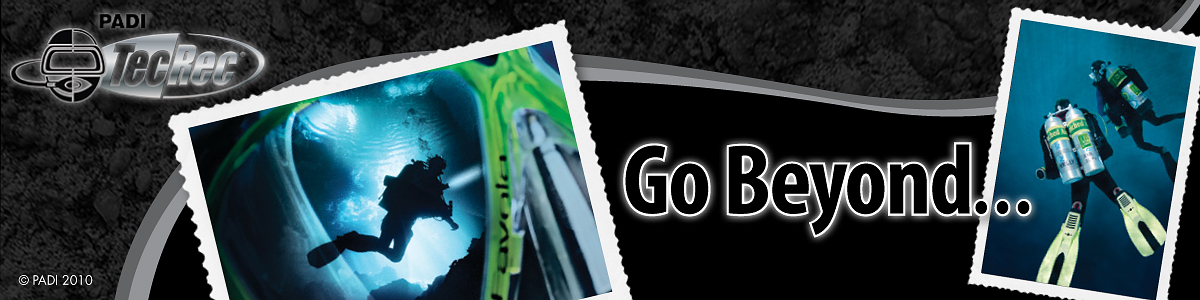
Welcome to the world of Technical Diving! I hope you find the answers to your
questions here!
Please
contact
Max Gilbert if you have questions.
“What is Technical Diving?”
Technical Diving is diving beyond Recreational limits with the proper training
and equipment. In other words, technical divers break the rules you learned
in your recreational diving training about depth and time limits. Tech divers
usually dive below 130 feet, and they usually incur a decompression obligation
that prevents them from ascending directly to the surface without making
decompression stops.
“Where can I go and what can I do?”
The Windjammer in Bonaire… she’s an old three-masted schooner that sank off
the north end of the island, in 190 feet of water. Still intact, she’s a
fantastic, but seldom-visited dive attraction.
Lake Jocassee, South Carolina… Remember the movie
Deliverance?
Lake Jocassee is the lake that was formed by the dam that was being built in
the movie. There’s lots of good wall diving, an underwater hotel, an old
bridge, and an underwater girls’ school. It’s where I go to do deeper dives,
and to do the graduation dives in the
Tec 50
course.
The
Andrea Doria…
Sunk in 1956 off the coast of New York after a collision with the
Stockholm,
she’s in about 250’ of water. Often called the “Mount Everest” of Technical
Diving, the
Doria
has been on my bucket list for quite a while.
The U-852… a German
Unterseeboot,
sunk off the coast of New Jersey during World War II. Not many people get to
touch this piece of underwater history.
“Why in the world would anyone want to become a Technical Diver?”
The answer to that question varies from diver to diver. Some technical divers
enjoy using and tweaking all the cool gear that’s required for technical
diving. Some divers enjoy the unique challenges that technical diving
presents. Lots of us have a need to go see what’s down there… just a little
bit deeper. Some folks just want to see if they have what it takes to be in
an elite crowd. Whatever your reason is, your hard work will be rewarded with
a strong sense of accomplishment.
“Who can be a Technical Diver?”
Just about anybody, with a few requirements. You have to be 18 years old, and
you have to be reasonably fit. You don’t have to be a world-class athlete,
but you should be able to manage your own equipment without assistance, in and
out of the water. You also need some dive experience and some training
prerequisites, which is covered in the sections on the course offerings.
Want to get started?
SDI has a couple of programs for you to “get your feet wet”. If you just want
to see what diving in a technical rig is like, you can join us for a Discover
Technical Diving experience. We’ll help you get geared up, and let you try it
out in a swimming pool. If you are a little more serious, but don’t quite
have the pre-requisite courses knocked out, you can take the
Discover Tech
class. I’ll help you get your own rig set up, we’ll do some dives together,
and then you can gain experience diving a technical set-up within recreational
limits.
Start walking the walk…
If you’re leaning towards technical diving, you may want to direct your
training and diving experience towards meeting the pre-requisites.
Because technical dives tend to be longer than recreational dives, and we
often go to deeper colder water,
dry suit
training is a must. You should be comfortable in a dry suit, and have 20 or
more dives in one.
Deep diving
experience and training is also required. You’re going to learn to dive
beyond recreational limits, so being trained to dive all the way up to those
limits makes sense.
Nitrox
training is also required. You’ll be using nitrox to decompress or to extend
the no-stop limits of your dive, so you need to know about all the cool stuff
we teach in the nitrox class.
Rescue Diver
is a great certification for everyone to have, but it’s a definite must-have
for technical divers.
Although it’s not strictly required, the new
PADI Self-Reliant Diver
course is highly recommended. You’ll learn a lot about technical gear and
dive planning, and you’ll be able to get some additional experience that will really pay big dividends.
Sidemount
diving is a technique long-used by cave divers, but in the last few years,
it’s gained a lot of attention in the recreational and technical diving
community. You can do all the technical courses in sidemount… your back will
thank me in the morning, but you will need training and experience in the
technique.
What gear do I need?
It depends on whether you want to do your training in
sidemount
or
back-mounted
doubles. Either way is fine. If you follow the links, I’ve made a complete
list for both options. For most folks, side mount diving is something
completely new and different, which means you need some
training
and experience in sidemount before your technical training.
What pre-requisite courses and technical courses does Southeastern Divers
offer?
Each of these courses gets its own page!
Nitrox
Deep
Drysuit
Rescue
Self-Reliant
Tec 40
Tec 45
Tec 50
Gas Blender
Want more?
Me too. I’m always digging into this topic or that subject when it comes to
technical diving. I’ve got a growing pile of articles that I’ve found useful
and interesting on this
page
Max
 Southeastern
Divers, Inc.
Southeastern
Divers, Inc.