 Southeastern
Divers, Inc.
Southeastern
Divers, Inc.2720 Governors Drive SW, Huntsville Alabama 35805 - Phone: 256-536-8404
"Training the best divers in North Alabama since 1980."
|
2720 Governors Drive SW, Huntsville Alabama 35805 - Phone: 256-536-8404
"Training the best divers in North Alabama since 1980." |
|
|
Max Gilbert PADI IDC Staff Instructor Gas Blender When I took my trimix class, it was the weekend after I had taken my DSAT Gas Blender class. My instructor, Lance Briner, who also assisted in the trimix class, helped me blend gasses for myself, him, and my primary instructor, Jeff Loflin. I was getting ready to do dives deeper than I’d ever been before, using gasses I’d never breathed before, and I was blending them myself. Needless to say, I was MOTIVATED to get the job done right! My need to blend gas came from my interested in deep dives on trimix, a gas with helium in it. The helium replaces some of the oxygen and nitrogen that’s present in air or nitrox, mitigating the effects of narcosis. I knew that after I came home from my training, I would want to do some trimix dives, and that the only way I was going to get any trimix fills was to be prepared to blend them myself! The Gas Blender class starts off with a discussion of why and when people dive mixed gasses (nitrox or trimix), and what the physiological effects of each gas are when breathed at depth. We discuss and calculate Equivalent Air Depth (EAD) for nitrox, and Equivalent Narcotic Depth (END) for trimix. After we discuss why divers need and want mixed gasses, we move on to the stuff you have to have to make mixed gasses… oxygen clean cylinders, oxygen compatible/ready tubing, blending stations, etc. The goal of this part of the course is not to make you a fill station designer, but to let you know the amount of care and consideration that goes into designing one, and why it’s so important. Finally, we move onto the nitty-gritty, the actual math behind partial pressure blending of mixed gasses. We work tons of examples on the board, and we also use some software to do the calculations for us. The class finishes up (maybe on a second day if there are several students) with you actually blending some gasses. If you just want to be a nitrox blender, you’ll make a couple of different nitrox blends. If you want to become a trimix blender, you’ll also blend some trimix. You’d better do a good job, because it’s very likely that one of us is going to personally breathe the gasses you blend! To take the class, you need to be a PADI Enriched Air Diver (or equivalent). The class is usually taught on a weekend, so plan on spending Saturday in the classroom, and Sunday at the blending station. “Sea” you soon… underwater, breathing my own custom blend! max
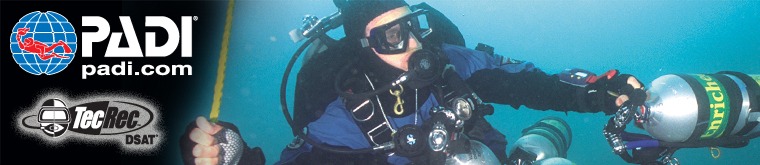
Check out the PADI Tec Deep Blog HERE! Southeastern Divers Technical Diving Courses The “New” Tech When I was coming up through the ranks of technical diving and technical diving instructing, PADI had just three classes. Tec 1, Tec Deep, and Tec Trimix. Each course represented a big commitment of time and resources just to get started. In addition to being a bit unwieldy as courses go, these coursed didn’t line up very well with the course offerings from other training organizations, which meant there wasn’t a good way for someone who’d trained with another training agency to switch over. A while back, PADI re-vamped the curriculum and made every thing better. For open circuit diving, PADI now has five classes in technical diving. Tec 40, Tec 45, Tec 50, Tec 65, and Tec Trimix. These courses line up just about exactly with the Advanced Nitrox, Deco Procedures, Extended Range, Normoxic Trimix and Full Trimix courses offered by other agencies, so it’s much easier to cross over to PADI/DSAT if you have taken these courses. There are also two classes that will help you decide if technical diving is your thing or not. Discover Tec is conducted in a pool, and lets you find out what it’s like to dive in a technical diving rig. Tec Basics expands on the Discover Tec experience by training you to do dives in technical gear but staying within recreational limits. Each class builds on the previous one and each one expands the diver’s limits so they can then do dives to ready themselves for the next level. The numbers in each course’s name are the student’s new depth limit (in meters) after completing the course. Tec 40 is the first course in the PADI/DSAT Technical Diving series, and students who successfully complete it will be qualified to dive to 40 meters (130 feet), using a single deco gas up to EANx50 to extend no decompression limits, or to use that gas to conduct actual decompression dives with no more than 10 minutes total decompression time. You’ll learn some dive planning and gas management skills, as well as lots of problem solving techniques. The pre-requisites for this course are Advanced Open Water Diver, Deep Diver, and Nitrox diver. Tec 45 is the second of the PADI/DSAT Technical Diving courses and in this course you’ll push through that 130’ recreational depth limit for the first time. After you successfully complete this course, you’ll be qualified to dive to 45 meters (150 feet), using a single deco gas of nitrox or oxygen to decompress or extend your no-stop limits. Your decompression limit is removed, meaning you can plan and execute dives with as much deco time as you want. This course also has some diving pre-requisites. You’ll need to have a minimum of 50 dives. At least 12 have to be on nitrox and deeper than 60 feet, and at least six (with or without nitrox) are deeper than 100 feet. Tec 50 is the third of the PADI/DSAT Technical Diving courses, and in this course, just like in Tec 45, you’ll go deeper than you’ve ever been before. After successfully completing this course, you’ll be qualified to dive to 50 meters (165 feet) using up to two deco gases of nitrox or oxygen to extend no-stop limits or to decompress on. In addition to all the pre-requisites for Tec 40 & 45, you’ll also need to have earned a Rescue Diver rating. Also, there are some dive experience requirements. You’ll need at least 100 logged dives. Twenty of them have to be nitrox dives, 25 must be deeper than 60 feet, and 20 must be deeper than 100 feet. To take these courses, you’ll need some gear that’s different from what you used in your recreational classes. For Tec 40, you can do the class in your recreational gear, but it really isn’t recommended… a set of technical diving gear is what you should have. You’ll need a set of double tanks (backmount or sidemount), a regulator for each of the double tanks, plus a regulator for each of your deco cylinders. For backmount, you’ll need a technical diving harness, or for sidemount you’ll need a sidemount BC. You’ll also need knives, two methods for determining depth & time, a canister light, two backup lights, a lift bag & finger spool and a couple of masks. Finally, though it isn’t “required”, I highly recommend that you have experience diving in a dry suit. Most of the time, it’s chilly to cold at the depths we’ll be diving, and a wetsuit just won’t keep you warm enough. There’s more information below about each of the courses we teach and a full equipment list. Think you’ve got what it takes to join the ranks of the diving elite? Want to have skills and control in the water better than everyone else? Come get started on your technical diving learning experience! See you underwater… deep, deep, deep underwater! max
Discover Tec
Tec 40
Tec 45
Tec 50
Divers will read the appropriate section of their TecRec manual and answer the Knowledge Reviews prior to the practical application portion. A score of at least 80% is required on all exams. Divers enrolled in the Tec 40, Tec 45, Tec 50 or Tec Deep courses MUST have DAN Master Plan dive insurance (or equivalent). Additionally, all divers MUST have a physician's signature to participate in the classes.
| |||||||||||||||||||||||||||||||||||||||||||||||||||||||||||||||||||||||||||||||
|
Best viewed with 1024 x 768 screen resolution. This page was last updated on 08/12/2014. Copyright © 2008 by Southeastern Divers, Inc. - No part of this website may be reproduced or copied in any manner without the express written permission of Southeastern Divers, Inc. |