 Southeastern
Divers, Inc.
Southeastern
Divers, Inc.2720 Governors Drive SW, Huntsville Alabama 35805 - Phone: 256-536-8404
"Training the best divers in North Alabama since 1980."
|
2720 Governors Drive SW, Huntsville Alabama 35805 - Phone: 256-536-8404
"Training the best divers in North Alabama since 1980." |
|
|
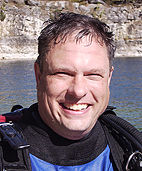
Max Gilbert PADI IDC Staff Instructor Where was Max when the sun went down? Where was Max at midnight? Where was Max when the sun came up? Underwater, of course! Diving at night has got to be one of my favorite things to do! It's great to be diving anytime, but night time adds something special for me. I guess it's that little extra thrill of disappearing beneath water that seemed so clear and inviting by day, but seems inky and forbidding at night. Any dive site takes on completely different look and feel at night. Creatures that were hiding during the day come out to hunt & feed, and we often see fish lying on corals, asleep. Lobsters, crabs, tarpon, and octopi are all night hunters, and it's really interesting to see them at work. When the sun goes down, the reef takes on a different personality. I often imagine that the reef is a city, and that all the daytime workers are swimming home for supper, and the night workers and party-goers are coming out to greet the evening. By midnight, things are really rocking and rolling. Lobsters are walking around, the octopi come out of hiding, and the krill go into action. At sunrise, all the night owls fly home to roost and the workers wake up to get busy again. No one ever takes a day off. I guess when finding food is your main occupation, calling in sick just isn't an option! I've had lots of interesting experiences on night dives. In Bonaire, on the House Reef at Captain Don's Habitat, there are several tarpon that will circle divers, using their lights as hunting aids. These fish are BIG, up to eight feet, with large scales, and eyes that look about two inches across. They will swim right past a diver without a care in the world. If you manage to sneak up on one, or get close enough to try and touch it, it will disappear into the darkness with one big tail swish so fast that it almost seems to vanish instantly! There's also a huge grouper that hangs out there. Once, I was holding a light on the grouper and a nearby parrot fish while my buddy Abbott was shooting video. All of a sudden, the grouper opened his mouth big and wide and the parrot fish was gone! Dinner was served. After that experience, I'm careful not to shine my light too long in one place. In addition to the tarpon and grouper, there are smaller things that go bump in the night. On our November 2009 Bonaire trip, I was using a new 10 watt canister light for the first time, and on several night dives, something swam into the back of my hand. It didn't hurt, but whatever it was was moving fast. I figured it out when the next thing I saw was a cloud of ink in the water. A reef squid was attacking my light! When it figured out that I was too big to eat, it inked and ran away. Once the mystery was solved, the whole thing tickled me. The corals do most of their business at night as well. The individual polyps extend their tentacles to catch just about anything that swims by. If you hold your light close to the reef long enough to attract krill, they will be trapped by the coral. The little tentacles wrap around the krill, making it disappear into the reef. You don't even have to look at the reef to see interesting stuff. Just hold your light still long enough and the tiny critters will come to check it out. Some of them are transparent and you'll only see their outlines. Others will bump into your light and swarm around it. Night diving is also huge fun in fresh water. At Vortex Spring, in Ponce de Leon, Florida, there are freshwater eels that come out at night. They will come right up to divers, eager for a handout of Vienna sausages or Cheese Whiz. At the Coffey Grounds, the largemouth bass sleep in the weed beds, and will shoot out to escape a diver that gets too close. Shine your light parallel weedy bottom and you just might show a big bass some bluegill minnows to eat. Night diving does take a bit of extra equipment. Divers need a primary light, a backup light, and a marker light. In order to be completely in the dark all of your lights, and all of your buddy's lights would have to fail. Backups for backups is a great plan. I usually take a second marker light to tie off underwater, so I can find my way back to where I came in. Navigation and depth control also take a bit of extra care, since there are fewer visual cues to help with these tasks. Good thing that compass glows in the dark, and your computer has a back light! Just having a light on a night dive doesn't mean you have to turn it on, however. My favorite night dives have been under a full moon. Of course, I took lights, for safety, but I left it off. Once my eyes adjusted, I was able to see what was going on without disturbing things in any way. Cool! There are plenty of opportunities for night diving coming up this summer. Starting May 5, I'll be opening the Coffey Grounds on Wednesdays. We'll be able to conduct just about any course you're interested in... Underwater Navigation, Search & Recovery, Peak Performance Buoyancy, Dry Suit, Advanced Open Water, and of course Night diver. Also don't forget there are still two spots open on the July trip to Roatan. Come along on that trip, and I promise to take you on some night dives! It's a good idea to take your first night dive with a pro, either as an Adventure dive on your way to a PADI Advanced Open Water certification, or as part of the PADI Night Diver course. We'll ease you into night diving, and not leave you in the dark! See you soon... underwater... in the dark! max |
|
Best viewed with 1024 x 768 screen resolution. This page was last updated on 08/12/2014. Copyright © 2008 by Southeastern Divers, Inc. - No part of this website may be reproduced or copied in any manner without the express written permission of Southeastern Divers, Inc. |