 Southeastern
Divers, Inc.
Southeastern
Divers, Inc.2720 Governors Drive SW, Huntsville Alabama 35805 - Phone: 256-536-8404
"Training the best divers in North Alabama since 1980."
|
2720 Governors Drive SW, Huntsville Alabama 35805 - Phone: 256-536-8404
"Training the best divers in North Alabama since 1980." |
|
|
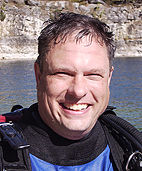 Max Gilbert PADI IDC Staff Instructor Hello Divers! Want to stay underwater longer? Want to stay on the surface less? Want to do it with less decompression sickness and narcosis risk? If you answered “Yes!” to any of those questions, then diving with EAN (Enriched Air Nitrox) is for you! Enriched Air – “Nitrox” for short – is a breathing gas that has more oxygen in it than air, which has about 21% oxygen. The shorthand for EAN blends is EANx##, where the ## is the percentage of oxygen that’s in the gas. EANx32 has 32% oxygen, EANx36 has 36% oxygen, and so on. Strictly speaking, while you’re sitting at your computer reading this message, you’re breathing EANx21, right? Pretty cool! You learned in your Open Water class that there are two main factors that limit your dive time. The first one is obviously the amount of air in your tank. The second is the amount of nitrogen absorbed into your tissues. At first, nitrogen absorption didn’t come into play that much, but I’ll bet that as you became a more experienced diver, you noticed that your air consumption went way down. At this point, you may have noticed than you sometimes ran low on no-decompression time before you ran low on air! Diving with nitrox extends your no-decompression time because there is less nitrogen in the breathing gas for your body to absorb. If there is less nitrogen, then you can stay down longer, have shorter surface intervals, or a combination of both! What about reducing decompression sickness (DCS) and narcosis risk? Decompression Sickness is all about having more nitrogen dissolved in your tissues than they can hold. If your breathing gas has less nitrogen to begin with, then DCS risk is automatically reduced. Nitrogen narcosis, though not fully understood from a physiological standpoint, seems to be the result of excess nitrogen interfering with nerve impulses in your brain. Again, if your breathing gas has less nitrogen, then narcosis risk must go down. As they say, there is no “free lunch”, and diving with EAN is no different. Breathing gasses with higher oxygen content carries with it some easily manageable risks. First, you can’t go quite as deep on EAN as you can on air – the maximum depth for the most common blend, EANx32 is about 110 feet. For our dream trips to Roatan and Bonaire, that’s plenty deep! As far as reef life goes, there’s nothing at 110 feet that’s not also at 60 feet, so unless you’re exploring a deep wreck, or have some other specific need to go deeper, then the EAN max depth isn’t really an inconvenient limit, but as you’ll learn in the class, it is a REAL limit. Second, when you breathe higher concentrations of oxygen, you have to track and limit your total oxygen exposure. It’s not a huge deal, and you’ll learn that you’d have to dive your brains out to even approach the oxygen exposure limit, but is something you’ll need to be aware of. Now, for the last bit of good news… You can take the PADI EAN class just about anytime you want! Stop by the shop, sign up and pick up the course materials. Read the book and answer the Knowledge Review questions on your own. Next, call SDI to arrange a classroom session. We’ll meet you, discuss the Knowledge Review questions, give you a short exam, and you’re done! The course fee includes a rental tank full of nitrox that you can take and use when you and your buddy go diving, or you can come and dive with one of our classes. “Sea” you soon! ~underwater! Max
|
|
Best viewed with 1024 x 768 screen resolution. This page was last updated on 08/12/2014. Copyright © 2008 by Southeastern Divers, Inc. - No part of this website may be reproduced or copied in any manner without the express written permission of Southeastern Divers, Inc. |