 Southeastern
Divers, Inc.
Southeastern
Divers, Inc.2720 Governors Drive SW, Huntsville Alabama 35805 - Phone: 256-536-8404
"Training the best divers in North Alabama since 1980."
|
2720 Governors Drive SW, Huntsville Alabama 35805 - Phone: 256-536-8404
"Training the best divers in North Alabama since 1980." |
|
|
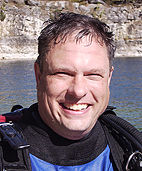
Max Gilbert PADI IDC Staff Instructor 2 Days + 6 Dives = 2 Certifications? When it comes to my own dive training, I’ve always felt that I just can’t get enough. I’m always pestering other divers with questions about this or that, or getting ready for my next training adventure. Even when I’m diving with my good buddy Abbott, I’m fine tuning and learning by observing other divers. If you twist my regulator hose, I’ll admit that not everyone has to take every course in the catalog, but I do recommend that every diver take the AOW class, Rescue Diver class, and the Nitrox classes. I’ve already written an article about Nitrox, so this month we’re going to focus on the AOW class. First, we’ll talk about what you have to do to become an Advanced Open Water Diver and then we’ll look into some of the Adventure Dives you can do. At the end of this article, I’ll tell you all about a great way to earn the AOW rating and the Enriched Air Nitrox rating in a single weekend! What do you have to do to earn the Advanced Open Water Rating? The answer is simple… five dives and five sets of knowledge reviews. Two of the dives and knowledge reviews you choose are compulsory. You must do the Deep Adventure Dive, and the Underwater Navigation dive. The remaining three can be any of the dives described in the Adventures in Diving book: Underwater Photography, Peak Performance Buoyancy, Dry Suit, Search & Recovery, Boat, Wreck, Night, and on and on. The Adventures in Diving Manual lays out so many options that it’s hard to choose! Let’s get started choosing by talking about some of those Adventure Dives. Perhaps the most important skill in all of scuba diving is buoyancy control. My fellow-instructor, Sean Davis, has written a fine article about it, and I don’t expect that article to be the last. We both agree that the Peak Performance Buoyancy (PPB) Adventure Dive is a great dive to include in your AOW training. Good buoyancy control has three major parts: proper weighting, just the right amount of air in the BCD, and breathing control. Proper weighting is more than just having the right amount of lead, it’s also about placement of that lead to achieve ideal trim in the water. Once the right amount of weight is precisely determined, you’ll find that you can dive with almost no air in your BCD. Finally with some hovering exercises, we work on fine-tuning your trim and breathing control. What if someone told you about the location of some seahorses on the House Reef at Captain Don’s Habitat in Bonaire? That location might be something like, “Go west from the dock 50 feet and then swim southwest 100 feet to some purple tube sponges. Turn due south for another 75 feet and you’ll find them next to an old tire.” Seahorses are hard enough to find, even when you have precise instructions. Could you follow these instructions to locate these wonderful creatures? With the skills you’ll learn in the Underwater Navigation Adventure Dive, you could! On this dive, we build on the navigation skills you learned in your Open Water class, teaching you methods to navigate more precisely. You’ll learn how to accurately measure distances underwater, how to navigate patterns using your compass, as well as how to use underwater landmarks to find your way. I think every diver has a fantasy about finding a chest full of treasure, just waiting to be recovered. I certainly always keep my eyes peeled for something shiny in the sand. So far, all I’ve found is some soda bottles and junk, but when I finally do find some gold, I want to be ready! Of course, most Search & Recovery work is more mundane. Perhaps a lost fin strap, a missing anchor, or a pair of sunglasses dropped overboard is what you’re looking for. The nature of the object you’re hunting and how it was lost play a great part in how you conduct your search. If you know precisely where those sunglasses went into the water, you would most likely descend as close as possible to that spot and search in larger and larger circles around it. If you just know that the missing anchor is “out that way someplace,” you would probably use a back and forth pattern to cover as much area as possible. Once the item is found, you can move to the Recovery part of the dive. You’ll need to know how to deploy a lift bag, how to tie it properly to the recovery object, and how to bring it safely to the surface. We teach you all these skills in the Search & Recovery Adventure Dive. While I can’t promise you’ll find gold doubloons or Pieces of Eight, I can promise fun! Sometimes, you just can’t help but wanting to go deep. I guess it’s just human nature to go higher, faster, farther, and of course, deeper. On the Deep Adventure Dive, we’ll help you learn to explore those limits safely. As you may recall from your Open Water training, one risk of deep dives is nitrogen narcosis. Before your deep dive, you’ll be given a puzzle to solve, something makes you use both your brain and your hands. One of our instructors or staff will time you as you work your way through it. Don’t worry! It’s not long division, but it will make you think a bit. Next, we’ll enter the water and descend to a depth between 60’ and 80’. We’ll spend a few minutes getting acclimated, communicating information back and forth such as depth and pressure. Once everyone is settled, you’ll get another puzzle to solve. Again, you’ll be timed and you’ll see just how much narcosis affects your brain! Finally, we’ll make a nice slow ascent to 15’ for a three-minute safety stop before ascending to the surface. Wrecks are great fun! There’s just something mystifying about seeing something on the ocean floor that isn’t supposed to be there. One of my most memorable dives was to the U-352 off the coast of North Carolina. When I laid my hands on that submarine, I was thrilled to touch a real piece of history. I’ve done dives on warships, old tugboats, fishing boats, and perhaps the most famous wreck in the Caribbean, the Hilma Hooker (link to the SDI travel blog). Every wreck has a story to tell, and exploring them lets us become a part of that story. On the Wreck Adventure Dive, we’ll teach you how to explore the outside of a wreck safely. It’s not hard, but it sure is fun! So far, we’ve talked about five of the Adventure Dives that you can do. You have to do the Navigation and Deep dives, but you can pick from lots of choices for the other three. To help you choose, SDI has a new program starting this May, our 2+6 = 2 program. Over the course of a single weekend we’ll do six dives, and you’ll earn two certifications. That’s 2 Days + 6 Dives = 2 Certifications. Here’s how the 2+6 = 2 program works. From May to October, every weekend after the Open Water class for that month is finished, we’ll conduct the program. On Saturday we’ll do the Peak Performance Buoyancy, Underwater Navigation, and Search & Recovery dives. On Sunday, we’ll do the Deep and Wreck dives. You’ll finish the day on Sunday with a Nitrox dive. You’ll be tired from all those dives, but you will have some great dive experience to build on. And here’s one more great piece of news… each of those dives you did for your AOW rating counts toward the PADI specialty diver ratings. Once you’ve finished the 2+6 = 2 program, you’ll have one dive done for each of five PADI specialty ratings, Peak Performance Buoyancy Diver, Underwater Navigator, Search & Recovery Diver, Deep Diver, and Wreck Diver. Because you earned the Nitrox Specialty as part of the 2+6 = 2 program you only need to finish four of the five specialties you’ve started and a Rescue Diver course to earn your Master Scuba Diver rating! That rating shows that you have the knowledge and skills to dive in all kinds of conditions. It’s hard work, but it’s worth it… you’ll have the very highest recreational rating that PADI offers! Take the first step with us next month! “Sea” you soon ~ underwater! max P.S. Just as I finished this article, I learned the self-study portion of the Advanced Open Water class is now available online. You’ll be able to complete and submit your Knowledge Reviews and have access to the full Adventures in Diving manual through your PADI eLearning account. Check it out at PADI eLearning. |
|
Best viewed with 1024 x 768 screen resolution. This page was last updated on 08/12/2014. Copyright © 2008 by Southeastern Divers, Inc. - No part of this website may be reproduced or copied in any manner without the express written permission of Southeastern Divers, Inc. |